
Book Review || Plaything (2024)
"Anna’s new life in Cambridge is full of promise but something is a little off."

: 🌕 : SPOILER ALERT : 🌕 :
It is important to note that most of the themes explored in this book deal with sensitive subject matters. My review, therefore, touches on these topics as well. Many people might find the book's subject matters & those detailed in my review overwhelming. I suggest you steer clear of both if this is the case. Please note that from this point forward I will be writing about matters that contain reflections on the death of an animal, infidelity, suicide, substance use, sexual image-based abuse (i.e. nonconsensual pornography), theft, & others.
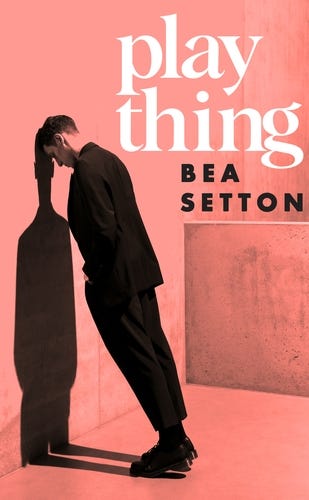
“And I was grateful for this miraculous reprieve. But I was not particularly surprised. So much had happened which out not to have.”
The tingle of a promise, ominous, loathsome, looming, renders the threat ticklish, gruesome, & exciting. When a promise is not kept, when something is hinted at, only to be forgotten, one is sunken in quicksand by the angelic hands of a friend. Literature that engages the tonal shift of enticement, one that lingers just outside of the deliberate letter, twinges inside the iris of the reader; the next page will hold something more; the scene that follows shall make clear what the smog has cloistered. Yet, the writer whose tone escapes them, like a mime who screams out in terror, leaves readers with disappointed spittle soaking their bib, where the saucy delight of broken ribs should have been.
‣‣‣
The author & I have met through her work in the past. When I first read Setton’s work “Berlin” (2022) I hoped to find the delight of oddity. The promise that lingers in the synopsis of Setton’s works breathes air into rotting lungs. Readers, like myself, who enjoy a challenge will be deflated upon completing the windmill-style turn through her plots but, readers who are unlike me will revel & gloat at the feet of the feast she presents them.
Both of Setton’s books appeal to a reader who is looking for a challenge. These readers are not seeking out Plato’s “The Republic” (375 BC) or Mikhail Bulgakov’s “The Master and Margarita” (1967), nor are they coyly ruminating on Yiyun Li’s “The Book of Goose” (2022). Rather, these readers enjoy the bizarre colours of a palette left unused; enough to make them tongue-tied when reality seeps its curious fingers into the spine & paralyzes the story where it stands.
These readers are fond of the odd as long as it remains caged; they long for the horror that can be seen through the screen of a protective visor; they are habituated with the heart’s murmur after a branch snaps in the woods. However, they do not seek to go outside the confines of their comfort. I do not begrudge them for this, in fact, I applaud their self-awareness. Setton writes for them & I am sure their hunger will be appeased by her second novel.
‣‣‣
In essence, this story follows Anna as she pursues her PhD at the University of Cambridge in 2020. The Coronavirus (COVID-19) has spread its wings & altered her inflated egotistical approach to life; she meets a handsome man & they have sex; her friends are smart & vapid all at once. The story follows her throughout the banal realizations that she comes to. She meets herself head-on, watching her actions in reflective services & in the whites of the eyes of the men she covets & yet, in the end, another woman is the magnificent beast that towers over the castle & castrates the love she seeks to possess.
Of course, this is an oversimplification. Anna sees a car crash, she has her diamond earrings stolen, & she is responsible for the death of a cat & multiple members of the rodent family. Anna is also a person who is allowed to make mistakes. She invests all her time with a beautiful man because he is beautiful & she is not. This makes her feel of value when all along she claimed to be better than women who were granted the blessing via their genetic code. The purpose of the narrative seems to encourage readers to empathize with Anna while also degrading her for the harm she causes those around her.
‣‣‣
The semi-automatic format of this story left me disappointed & winded. I had succumbed to the enthusiasm granted to me in the opening scenes; a dual car crash, a chase in the roadway, pounding fists of violence, a runner, & first responders who never arrived. Yet as the novel roared onward, these scenes—my promise of horrors set to be unearthed like the ravenously broken jaws of a corpse—never gave the reader, or the story, more than what they had at their introduction.
The cars were driven by Caden & Jack, brothers who sought out Giselle, the woman turned monster as a consequence of having everything. The absence of first responders was nothing but a fluke & if you live in a city not unlike my own; this ominous fiction is also an unfortunate reality.
‣‣‣
For reasons I cannot quite explain, I read this entire book hoping that Setton would return to her work. The pause of the tone of malevolence that she incorporated early on was all but abandoned, as though the woebegone banality of a woman self-declaring herself smarter than others was worth all the pages she dedicated to her. I suppose that at some point I decided that the crudely boring nature of the seesaw was something I could masticate; it was no loss to me to spend a few hours waiting in the wings for Anna to become the villain I knew she could be.
‣‣‣
I have been clear-cut with my disdain for the lack of direction in tone & trajectory in this story. However, I did read the entire book. As I have said, there are reasons for this, some of which I might not be able to discern but, should I take a moment to reflect, it is no secret to me that the primary reason I was able to do so was because Setton’s writing is easy to digest.
There is no depth to the vernacular that is employed, even when the characters are expressing the depths of their theologies. This is not something I find fault in, rather it is helpful to approach this style of story with monotonous language that engages every reader; one need not be a theologian or astrophysicist to comprehend the underbelly of the women’s studies at Cambridge.
On the other hand, the links that formed between subjects explored, both among the characters & the flow of the story could have been allowed to seep further into the plot. That being said, I am not certain that Setton wanted to write a devoutly amoral & overall heinous story.
My conclusion is that she wrote the story she had in mind; I appreciate her efforts & her success in doing so. This leads me to ruminate on feelings of vexation; I know she could have done more.
‣‣‣
This book is a prime example of what it means to attract a person who is unlike the self. I know I am not the target reader & I would be hopeful in stating that Setton might agree. There is a part of me that longs to encourage her to go deeper, to drive home the homilies of terror that linger just outside of her spider’s web but, this is not what she has wanted to do.
This review should not act as a call to action; the author has written out page after page about a character who can be forgiven by the right audience. Setton’s story is about a woman who is still very young. The main character is twenty-three & as someone who was once this age, a moon or two ago, I understand how very juvenile a person of this age is, in reality, now that I am no longer shooed in this very space by birthdays & sentient holidays.
Her mistakes are quite horrible & her decision to remain engaged in a rumpus dull relationship with Caden is boring but, Anna is still growing. The world has yet to open itself to her. When she speaks about her childhood & the nature of her family dynamic, the reader will note no horrific trauma; there exists only the sullen nature of a rainy day & parents too egotistical to care.
Do not mistake me, I firstly do not wish for anyone to be traumatized, it is a rather despairingly drunken state to live in. Secondly, the minutia of Anna’s experiences are not ones I seek to diminish. Rather, I highlight her family life, her upbringing, & her character as markers of a person who has not necessarily had the opportunity to be faced with the terrible things that do exist, in plain sight.
‣‣‣
Anna’s father is a beast, like many men—many women, if we are being honest—he wants his wife to be thin, he has opinions that are always correct & he cannot accept the nature of nuance that exists in the human species. Anna’s mother is frail & angry, she does not seek to escape her cage as it defines her as a woman of the house; a kept flower in the forest burnt to a crisp.
Neither parent is particularly spectacular. Feeding your children wet dog food ranks rather uncomfortably as a nasty thing to do. However, Anna has an inflated ego as a result of the comfort of her home & therefore is poorly prepared to deal with the ferociously complicated nature of real life.
‣‣‣
During the earlier parts of the story, I found myself displeased with Anna & entirely uninterested in what she had to say. She covets the nature of her superiority as though readers have not walked the streets of life, once, if not twice. I found her character entirely dull & yet, she was the narrator. From some point in the future, she felt within her a challenge & desire to tell us a story. This same story ends when Giselle, Caden’s ex-girlfriend, follows her down the path to what one might assume is her death. This leads me to the nature of the secondary & tertiary characters.
‣‣‣
Setton fleshed out her characters well. By nature, this story is not profound & does not explore the depth of the situation at play. It will not come as a surprise to readers such as myself that the story ends on a distinctly ambiguous note.
As I read, I wanted to have the story told to me by someone who would be honest. I did not trust Anna to be able to be clear with her thoughts or her experiences. She transformed everyone around her into villains. Perhaps, Caden did commit suicide & perhaps, Giselle is riddled with regret for the pain she caused. The reader will never actually understand the parameters of what is truth as Anna does not look to speak it.
‣‣‣
Truthfully, I did not hate this story. I will seek out Setton’s work again. However, I did not like this story either. I did not want to accept that there was nothing more to this story than a peculiar triangle meshed with sodden lake water & drowned in disregard.
There is a scary story that can be found awaiting the curtain behind the nature of reality that is often cocooned within bulbously tepid stories. Anna toyed rather romantically with death on more than one occasion & she felt it her due to live on. Her pleas to die were to the void, something she knew would never answer her. Would it be cruel to say she is a coward for calling into the Dark Matter to have a desire fulfilled while she is aware that it cannot deliver?
‣‣‣
Ultimately, the body of this text is dull because it altered the course I wished to run; I wanted servant’s bodies & biblical slices of clay & skin to render my hands into anguished clusters. Instead, I was met with a monotone girl who is blonde & thin; she is educated & well-off; her goals are achievable & people will forgive her cruel naivety because one time she cried alone.
How utterly unforgivable it is to forget that Anna is also a person who engaged in sexual image-based abuse. Therefore, forget, the reader shall not. In life, forgiving & forgetting seems to be done in tandem & maybe Anna will be able to bloom into a person, unlike the one we met in this book. However, one must not forget that consequence is often the lingering encourager behind change.
‣‣‣
I peruse the muddy river & those early rising who breathe a mist that flows from the mouths of the silent people in Cambridge like a ghost, haunting the very streets that hide bombs underneath. A narrator’s cool temperament does not excuse a boring tale. No lore can reinvigorate the tonsils extradited from the cavity of the mouth, so one must therefore choose whether to speak or remain silent.
Were the diamond earrings worth hiding in plain sight? Was the secret worth keeping that killed the cat who sought out the warmth of a cave of wonders, Anna could not invade? What is certain is that the freedom to leave off here is mine to hold & yours to accept & so, with these words we part ways, possibly never to meet with this sordid tale of fictional sadness, ever again.
Thank you to NetGalley, Random House UK, & Bea Setton for the free copy of this book in exchange for an honest review!
C. 💌